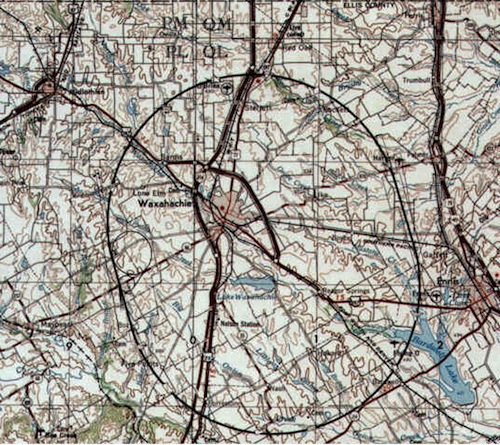
World’s Largest Super Collider: Abandoned
A supercollider is a large ring designed to accelerate particles of protons and anti-protons until they collide, the purpose being to create high amounts of energy. In the mid 1980′s, the United States wanted to construct the largest particle collider in the world. What was to be called the Superconducting Super Collider (SSC) began as an idea in 1983.
By 1987 Congress had approved the $4.4 billion dollar budget for the project, and by 1991 a site had been chosen in Texas and construction began.
*
By 1993 the cost projection had risen to over $12 billion. With limited financial resources, the U.S. government was forced to choose between funding the International Space Station (ISS) or the super particle collider. Congress approved funding for the ISS and on October 21, 1993, the SSC project was cancelled.
When the project was cancelled, 14 miles of tunnels and 17 shafts had already been dug, as well as all surface structures completed.
Total spent: $2 billion.
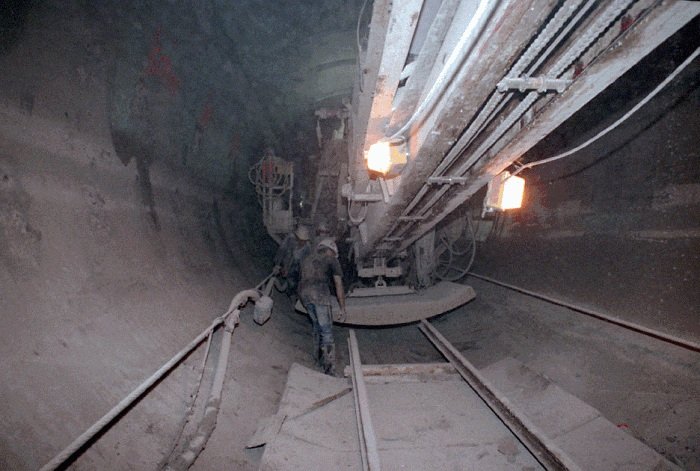
(Click thumbnails to enlarge)
After project cancellation, the site was given to Ellis County Texas. Numerous attempts to sell the property failed until 2006, when a private investment group finally purchased the property. It was rumored there were plans to use the SSC as a tier III or IV data center, but in 2011 the property still sat derelict and abandoned.
All of the collider equipment has been removed except for some underground generators in the tunnels.

For perspective, the largest currently operating particle accelerator is the Large Hadron Collider (LHC) at CERN in Switzerland. CERN LHC’s collision energy output of 14 TeV (Trillion electron-Volts) is dwarfed by the planned output of 40 TeV for the Superconducting Super Collider.
So why did construction of the LHC succeed where the SSC failed?
CERN’s construction of the Large Hadron Collider on a property that already had tunnels was a big factor; excavating millions of tons of earth proved to be the most expensive part of the construction process.
In addition, the SSC was intended to be much larger than the Large Hadron Collider, so naturally costs would be higher. It was the unforeseen costs that would grow exponentially in size along with the project that would do the SSC in.
The largest completed particle collider in the United States also happens to be the third largest in the world: the Tevatron, completed in 1983 at a cost of $120 million, is located at the Fermi National Accelerator Laboratory (Fermilab) in Illinois.
The Tevatron is much smaller in scale than the Superconducting Super Collider; it only produces 1 TeV at maximum output.

Unfortunately due to budget cuts, the Tevatron at Fermilab ceased operations in October of 2011. The costs associated with operating a collider – even on a smaller scale – outweigh the benefits in today’s budget landscape.
The second-largest collider in the world is now the Relativistic Heavy Ion Collider (RHIC), run by Brookhaven National Laboratory (BNL) in New York.





the SSC should have contacted my garden-crazed mom. she would have excavated millions of tons of earth for free!
Love this blog. Keep it up.
We could sure use an office chair…
Also loving this blog. All these posts are great time wasters at work. Keep em coming!
Actually I think this facility was purchased right around the time this article was published. I think it was bought by Magnablend. Remember last October 3rd the giant explosion at a chemical plant in Waxahachie, Tx?
it was all over the news globally. Well under the guise of “keeping jobs local” the Commissioner’s court secretly passed resolutions to lift deed restrictions on the property, no company requiring a TCEQ permit was allowed to operate there and then started raising the weight limits on the roads to accommodate the chemical trucks.
The SSC sits in the middle of residential areas and farm land. The Magnablend company receives violations with TCEQ at their powder blending facility and hundreds of fish and other aquatic life died where they were dumping the run-off water from putting out their explosion and inferno on Oct. 3rd…which they still have not cleaned up nor will they recognize that people living in the nearby area were made sick from the toxic smoke the fire created.
http://www.huffingtonpost.com/2011/10/04/waxahachie-chemical-plant-fire-pictures_n_994073.html
Thanks for the update & the link. I appreciate it!
I live about 4 miles from this site, and about 10 miles from the now vacant Magnablend facility. I am NOT happy that Magnablend will be operating out of this facility. There is a dairy farm literally across the street, as well as a boarding stable for horses and numerous other beef and dairy cattle operations within the perimeter. Of course, as things are, money will always trump concern and the Magnablend facility will end up here despite the possible environmental effects to the surrounding area.
Was it really abandoned and the project lost funding or did the events of the popular game Half-Life occur in the tunnels underground here?
Is this the Apeture Science Enrichment Center ?
There is a very good fiction book based on this place. It’s called A Hole in Texas, by Herman Wouk. Excellent read.
Read this and concur. I mean, the guy has won a nobel prize.
interesting – I’ll definitely look for the book – (hint to family and friends – I love to read herman Wouk novels – always on an interesting subject.)
anyone else think this could be one of the most ideal locations for a zombie apocalypse
I have actually been to this place about 3 years ago. Pretty cool to find out what it actually is. Good stuff!
bike park / skate park?
If both Europe and the US had collaborated on this project (Like ISS) the world could have had a collider 10x more energetic than the LHC, and would still be significantly more so even with the new 2014 upgrade. It would have been 3x the circumference… how much equipment could have been placed in that space? Think of the scientific impact that could have had? Rather then get all “Herpy derpy we are better” be sad that the information this could lead to will not be discovered for at least another 7-10 years (LCH phase 2 will bring about significant changes).
With all this structure present, why didnt they use this site to build the LHC?
Because there was already a lot of related equipment at the CERN site where the LHC was built.
What a waste of money… It’s too bad.
Dr. Toll left this project and then became President of Washington College
Some corrections:
eV = electroN-volt (not electro-volt), since it’s the amount of energy gained by an electron over a potential difference of 1 volt.
The Tevatron reached 2 TeV, not 1.
RHIC is a heavy ion collider. If you consider heavy ions “particles,” you’re a chemist.
(Also to one comment: the larger ring would not have meant more space for experiments. It would have been filled with accelerator-ring equipment. The limiting factor for the experiments is the useable [integrated] luminosity. However the 40-TeV energy reach already by the mid 90s would mean physics would be 20 years further down the road than it is now, experimentally speaking.)
I actually have a science fiction project set in this location, Schrodinger’s Heroes. Someone bought it and finished it, and a mishap turned it into a dimensional portal. Much adventure follows. Many quantum science tidbits have found their way into the stories, poems, and other material.
Thank you SO MUCH for this article and photos. This will be very helpful in adding further detail to the project. I’m always looking for more information on the Waxahachie supercollider.
Best. Urbex. Location. Evar.
Why do I have to live all the way over in the UK…
didn’t stargate command take it over in their battle against the replicators
One of the first visible signs I thought of the scientific disengagement that the US has been going through for the last 20 years or so. Unless it is entertainment or sports driven, forget it.