Home > Abandoned - Explained, Amazing, Asia, Creepy, Explained > Over 200 Dead Bodies on Mount Everest

Over 200 Dead Bodies on Mount Everest

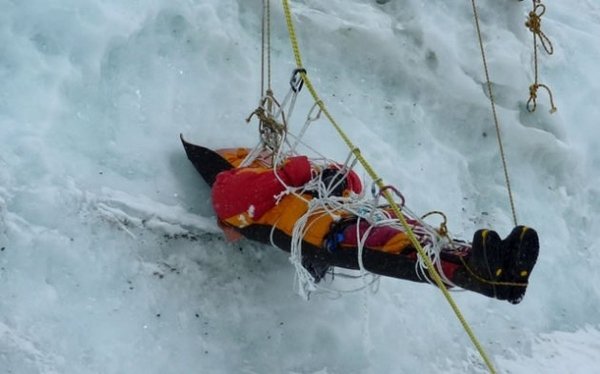
As of mid-2011, Mount Everest has claimed the lives of over 216 known mountain climbers. The area above 26,000 feet is called “the Death Zone”, where breathing fresh oxygen from canisters is necessary for all but the most experienced climbers. The atmospheric pressure is about a third of that at sea level, meaning there is about one third the amount of oxygen to breathe.  The air is so thin recovery of bodies has proven impossible.  Given this, many victims lay where they took their last breath.

**

Sergei and Francys Arsentiev

“PLEASE don’t leave me,” the dying woman cried.  Two climbers heard the screams of Francys Arsentiev, an American climber who had fallen after succumbing to snow blindness and found herself separated from her husband.  They were in the death zone, they were low on oxygen, and the woman was on the side of a steep cliff; carrying her was not an option.  The trip just to get down to her would be a risk of their own lives. Despite the risks, the two climbers – Ian Woodall and Cathy O’Dowd – climbed down to her and did what they could to give her assistance.

But it was too late.  Ian and Cathy administered oxygen and tended to Fran, but there was nothing they could do. They returned to base camp to seek help and report their findings.
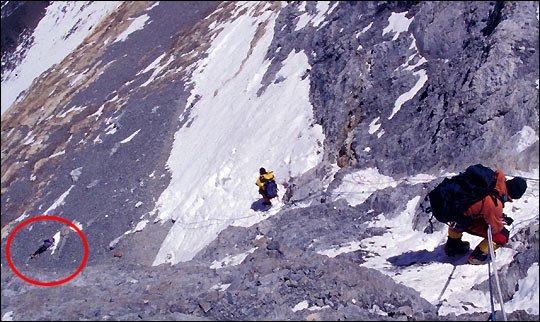
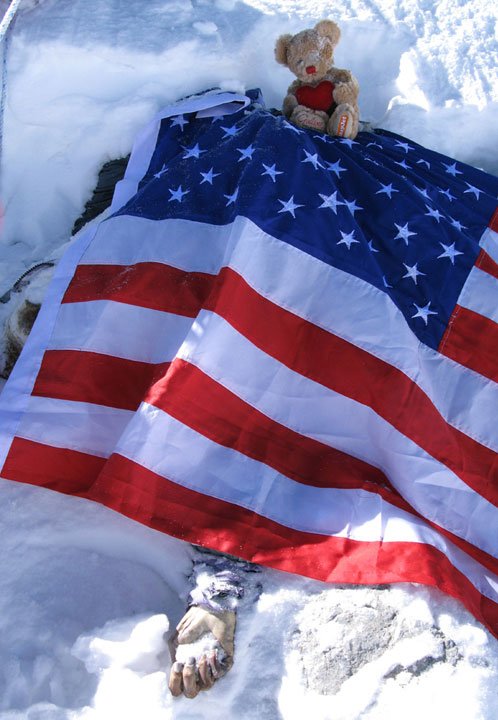
Eight years later the two climbers would return (above). In an attempt to give Francys a makeshift high-altitude burial, they would place an American flag on her body along with a note from her family.

At the time of Francys’ death in 1998, no one knew what had happened to her husband and climbing partner Sergei. He had been climbing with her and had disappeared around the same time; all that had been found were his pick axe and rope. On the day Francys died, other climbers had last seen Sergei far ahead of Francys on the descent after the two had accidentally become separated.

Everest-Francys-4

Sergei & Francys

Looking for his wife, Sergei later backtracked toward the summit despite knowing he did not have enough Oxygen to last. His exposure to the harsh conditions on Everest so far had been all he could handle, and he was beginning to suffer from frostbite. Still, Sergei would not leave his wife behind.

Sergei had made his way back to Francys, and descended toward the cliff she lay on as she screamed for help. Sadly, he fell to his death trying to reach his wife.

(Click thumbnails to enlarge)

Everest-Francys-2 Everest-Francys-3 Everest-Francys-1

Francys Arsentiev before her death; Francys memorial

**

Green Boots

PaljorPossibly the most famous body on Everest is that of “Green Boots,” an Indian climber named Tsewang Paljor. Paljor was a Constable with the Indo-Tibetan Border Police who took his last breath on the 10th of May during the famous 1996 Mount Everest Disaster. Paljor was part of a three-man group that was attempting to be the first Indian team to ascend Mt. Everest from the Northeastern route. The weather that season was worse than otheryears and 1996 proved to be one of the deadliest seasons for Mount Everest climbers. When the storm rolled in, visibility went to zero and the temperature dropped considerably.  Separated from the climbers in his group and suffering from the cold, Paljor found a small cave and huddled inside for protection from the elements.  Little did he know that would be his resting place for the next 15 years. (below)

**

George Mallory

One of the more storied climbers that met his fate on Everest was George Mallory, a famous English Mountaineer.  In 1924, Mallory fell to his death during a storm while attempting to be the first to reach the summit of Everest. His body was discovered in 1999 during the Mallory and Irvine Research Expedition. Decades earlier, Chinese climbers had reported seeing a “European body” laying face down on a shelf off the main trail. Given the description and the date of the find, experts had always assumed it was the body of Andrew Irvine.  Irvine was another famous English Mountaineer who had attempted the ascent of Everest with Mallory and perished in the same storm.

During a 1933 Everest expedition, climbers found Andrew Irvine’s axe and rope.  Because of this, it was widely believe to be Irvine’s body discovered by the Chinese. When the body was found during the 1999 search expedition, it was discovered to be that of George Mallory, not Irvine.  Mallory was found face down in a bunch of shale with his arms spread out and up.  His skin was in remarkably good condition but was tanned from 75 years of sun exposure.  After examining the body, experts hypothesized that Mallory’s rope had failed as he was found with a short severed rope tied around his waist.  He was also found with a golf ball-sized hole in his forehead, indicating he might have suffered blunt force trauma from striking a sharp rock.  Andrew Irvine has never been found.

Video of the Mallory Body Find on Everest:

**

The morbidity of seeing hundreds of bodies along one’s ascent up Mount Everest is only trumped by the fascination of the levels of preservation of many of the bodies.  The temperatures are ideal for long-term preservation; perhaps some of these corpses will serve as studies for generations thousands of years from now.

Or maybe not?

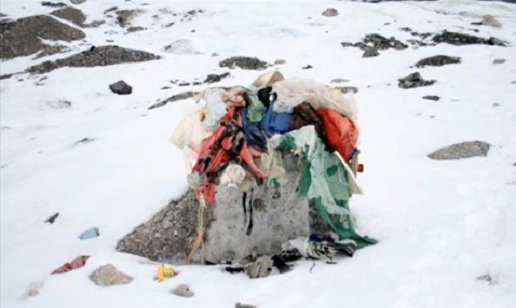
The Nepalese consider Mount Everest sacred, and do not want it to become a graveyard.  Many parents of those who have perished have asked for the bodies to be left as they were when they died, but this is against Nepalese law.  As soon as a body can be reached for retrieval, it is and then is brought down for identification and burial. Those too high for retrieval will have stone tombs (called cairns) constructed around the corpses to shield them from the elements and the view of other climbers.  A few corpses located on shallow ledges were rolled off to be buried in the snow below, away from the trail.

(Click thumbnails to enlarge)


*

David Sharp

A more recent story is that of David Sharp.  David was an English mountaineer who, in 2005, ascended Everest in a group but attempted the final climb by himself.  At one point he stopped in a small cave and eventually froze to the point he could not move.  As he lay near death below the summit, he was passed by over 40 other climbers both on their way up and their way down.

Sharp had stopped to rest and protect himself from the elements in the same cave Green Boots had used.  Since David was not moving, the 40 climbers that passed by had either not seen him or assumed he was Green Boots.  A group of sherpas in a later expedition on the way up to the summit noticed Sharp just off the trail, alive and moaning. When the sherpas reached David, he was not coherent and badly frostbitten – but he was able to say his name and which party he was with.

After giving David some oxygen, the sherpas attempted to help him climb down but he could not stand under his own power. Realizing Sharp was not going to be able to move, the sherpas pulled David into the sunlight hoping the sun exposure would warm him up.  By the time the sherpas returned to camp to report their find, David was dead. The last party to see Sharp alive was the documentary crew filming the ascent of double-amputee Mark Inglis.  Since they were filming, they had cameras rolling when they approached David and the footage was used in the documentary.

“Dying for Everest” – a short documentary outlining the David Sharp case including video of Sharp next to Green Boots:

Below: David Sharp’s memorial, David Sharp, and Green Boots’ Cave where David Sharp was found


**

Some died peacefully in their sleep, while others (who fell and/or became injured) were left to die slowly of hypothermia.  Until recently, the statistics were nearly one in four climbers dies attempting to reach the summit.  Advancements in technology and experience have led to a better survival rate of climbers.  Currently about 1,000 climbers a year attempt to reach the summit, and on average 15-20 perish.
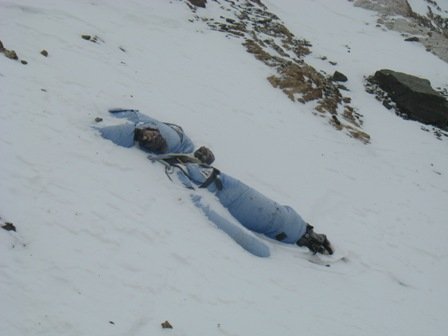
Expeditions are the primary source of income for Nepal, and licenses to ascend start at around $25,000.  If you have lesser experience and want to ascend with an experienced group, several companies will lead you to the top with a team of sherpas for prices starting around $40,000 per person.

Quick video of a discovered body:  

Satellite & Map: here

* May the climbers who have perished on Mount Everest rest in peace. *

**

About these ads
  1. J. Paul
    May 25, 2012 at 10:46 | #1

    Yeah but Lincoln’s rescue was different. It is not an apples to apples argument. For one thing Lincoln was not carried down, he was still able to walk. David Sharpe in contrast could not move. And with the density of oxygen being what it is above 8,000 meters, trying carry a 185/lb. person would be like trying carry a 350/lb. person across an ice skating at sea level without falling. The upper summit ridge is knife edge with moderate to difficult mixed rock/ice cramponing, in a spot that is very exposed. No one could have helped Mr. Sharpe except for Mr. Sharpe.

    When I was learning to BASE jump my mentor made me write a letter to my family and friends explaining that I had died BASE jumping and why I chose to do such a semi fly foolish thing. He will give it to the appropriate people should I die on a BASE jump. The bottomline was that he wanted me to understand I was choosing to do something very dangerous and that ultimately my safety and well being came down to my own decision at the end of the day. My well being was in my own hands. This same rationale goes for the dead people on Everest, most of them hopefully knew this before heading up there.

  2. joe from tampa
    May 25, 2012 at 22:39 | #2

    lets be realistic, everyone in this comment section including me is an internet warrior, so you and i can make fun of this all we want, but none of us would make it even a 3rd of the way up this mountain.

    • Woodat
      May 19, 2013 at 14:24 | #3

      And who would want to ?!
      I don’t know what to think of people who attempt to climb Everest. Do they have a death wish ?
      I don’t mean to sound nasty but I do not admire anybody who climbs Everest. -To punish your body for absolutely no reason ?!

      To pay $75,000 and then to be wasted at 28,000 feet, die and remain as a pathetic reminder of the silly decision they made to climb Everest. -Bodies of dead climbers to me are like an insult to their families, their bodies exposed to the elements, abandoned, just lying there for all to see. Sad and sheer madness !

  3. Jay
    May 26, 2012 at 09:33 | #4

    WOW! lmao… I feel sorry for the climbers that didn’t make it. But I think they are nuts for trying to do something that is close to impossible. After the 200th death you would think that they would learn. I feel bad for the families who have lost a loved one because of a bad choice to do something so dangerous to atempt, it’s selfish. No matter how “experienced” you are it is just a bad idea to try this. I feel bad that the ones who died may have suffered a while before they died. The fact that so many have died for nothing is sad. Putting yourself in a position where the chance of survival is slim is dumb. It’s like asking for cancer. I hope other climbers make the choice not to attempt this summit. And why is everyone fighting on this thread???? Stop being so nasty to each other.

    • Ryan
      April 5, 2013 at 09:21 | #5

      Died for nothing? Sad? I respect your opinion but Jay, do you really have to be such a jerk? Your personality is such that you don’t understand that the risk of death is exhilarating to people attempting to climb Everest; it adds to the challenge. Your mind is incapable of understanding the mindset of an Everest climber, so you rather label them as stupid and protect your ego. Your response is typical of people. When you don’t understand something, you write it off as stupid. Nothing wrong with that but it does make you look like a jerk.

      • Woodat
        May 19, 2013 at 14:31 | #6

        Hi, Ryan. -Maybe Jay put it in a sharp way but I agree with him. Joe public does not have to understand or even to judge but the public has a right to an opinion. -If what the climbers have as motive is the exhilarating feeling that they could die then they are fools and have some sort of death wish. Jay is right. They died for nothing, putting their families through misery for absolutely no purpose whatsoever… in fact a very selfish on their part
        Look at that, over 200 bodies up there, “now thawing and polluting the watter the natives drink”

  4. michael gillissen
    May 26, 2012 at 17:47 | #7

    I will apologize in advance for leaving my corpse somewhere u may come across. But if u look closely there will be a smile onmy face. Canyonering, snowboarding and mt climbing are what make life interesting. we do it in spite of the risks and not because of it. May each of u who love to experience life in real time and not in your mind find the joy and bliss u desire. Long live the adventurous spirit.

    • Woodat
      May 19, 2013 at 14:35 | #8

      “adventure” ?
      I find it as much ‘adventure’ as suicide is adventure.
      In my books an adventure is a very risky act bur with a purpose… not a selfish reason for doing it.
      (I apologize if my English isn’t up to scratch but English is not my mother tongue)

  5. mark
    May 27, 2012 at 00:57 | #9

    its disgusting that someone who has too much money and greed to just get to the top can walk past a fellow human who is dying.
    i would much prefer to sit at home knowing i had saved someones life than climbed a mountain that an ascent of these days is not an amazing feat of mountaineering skill.being short roped by a sherpa is NOT mountaineering

    • kagmcp1
      April 23, 2013 at 14:26 | #10

      You would not be able to save their life. The end result would be you would die as well trying.

  6. Rob
    May 27, 2012 at 10:04 | #11

    Any of you kids ever been above 8000m???i think not…

  7. Rob
    May 27, 2012 at 10:14 | #12

    i am typing this on my android right under the Serac of K2 hope i make it home

    • J. Paul
      May 30, 2012 at 15:56 | #13

      What route are you doing on K2? Abruzzi? The northwest ridge looks pretty sweet. Good luck! Have fun! ;-)

  8. Max’smom
    May 27, 2012 at 19:46 | #14

    I’m not an alpine adventure seeker and know nothing of the sport outside of what I read because of a severe disability and morbid fear of heights. This, along with other stories about Everest and hikes to the summit resulting in death, gives me pause. I am shocked at the callous manner with which the dead are treated not only on the mountain but on the thread. Human beings deserve respect in life and in death. I will never understand leaving anyone behind so I may complete my schedule. Even if I were able, I would not adventure up the mountain only to pass the bodies of people who died and have been left to be made into spectacles.

    • Div
      February 24, 2013 at 11:23 | #15

      All those that climb this peak have no respect for their own lives, how can they respect anyone else’s. They are all drivin by selfish ambition and many have left their wife and children behind knowing the very high risk of loosing their life.

      • juno
        February 25, 2013 at 22:15 | #16

        Much agreed !!

      • February 28, 2013 at 22:47 | #17

        I’ve always thought that too.

      • grahamk
        March 3, 2013 at 14:33 | #18

        But it is their life. How people choose to live their life is the fundamental freedom we are all entitled to, and if using that freedom to do something this dangerous is how you want to spend the currency that is your lifespan then I have no choice but to respect that

    • nicole
      March 27, 2013 at 23:48 | #19

      The climbers that came across the bodies are most likely NOT a rescue team…im sure they do what they can but they have to be careful not to put their lives too much at a risk. Or they will end up dying right beside those needing help. They are there to attempt to climb the mountain too. Its a chance they all take and they all know that if they were in the same situation, many will try to help but are less likely to risk ending up in the same situation as the the injured. And if you are REALLY that concerned, learn how to climb and go give a “proper burial” to those that unfortunately perished. Just know that you will probably perish too. They rested in peace doing something they wanted to do.

  9. Jeff
    May 28, 2012 at 21:22 | #20

    I find it fascinating that they leave the deceased up there. Rest in Peace for those who perished trying to accomplish a feat which I would assume most were their dreams. If I was an avid climber trying to reach the pinnacle, I obviously wouldn’t be on here typing, but would probably want to be left up there as well. These photographs are a good reminder of just how brave and fearless these climbers are and we are here at sea level watching sportscenter.

  10. dude
    May 29, 2012 at 22:30 | #21

    Hypothermia isn’t even close to the most unpleasant way to die. It’s over in a few hours. Dying of dehydration or starvation after being trapped for days would be worse. Severe burns would be worse. Severe trauma that didn’t kill you outright would be worse.

  11. May 31, 2012 at 09:52 | #22

    Everybody dies, but not everybody lives

    • That Guy
      June 1, 2012 at 01:16 | #23

      Passion knows no bounds

  12. blogzilla
    June 3, 2012 at 04:09 | #24

    For those of you wondering why there are people that still climb this mountain, even though it’s extremely dangerous and many people have met their death attempting the climb, well the answer is simple. Some have survived the trek and lived to tell about and come back home and live their daily lives. Not everyone gets picked to be on American Idol either, even though millions try out, but some do and make it.

    • juno
      February 25, 2013 at 22:18 | #25

      must love the stories they tell….” i was descending Everest when i step on a dead body what a fun trip it was!!!!!!!

  13. never climbed
    June 25, 2012 at 15:33 | #26

    where can I watch dying for everest?

  14. July 7, 2012 at 02:13 | #28

    May god Bless them death..

  15. Rance
    July 10, 2012 at 12:11 | #29

    like moths to a flame they just keep coming back….

  16. g.r.r.
    July 30, 2012 at 19:56 | #30

    I have to say that if it were me, I would insist that my body remain esp. if I in the death zone. First to risk others to retrieve my body is not right. However, more importantly, imagine how much we have learned about past humans by the mummys that we have found. For example the ice man in europe gave us lots of information. We have mummys from South America, and obviously the middle east.

  17. Alex
    August 27, 2012 at 17:41 | #31

    With all the advancements in technology I would photoshop myself at the top. Figure save thousands and have a 100% survival.

  18. Aaron
    August 29, 2012 at 20:01 | #32

    You would think with all the bodies popping up, that people would stop climbing that mountain. Obviously they don’t realize that it’s undefeated. The might Mount Everest.

  19. Alien Technocrat
    September 22, 2012 at 14:04 | #33

    I hope, sometimes a hotel will be built on the Everest, with a big, broad way to go with car up and down. I really loved this.

    And then, this mountain-climbing idiotism had an end. People could go to the everest with their car, rent a good food, and sleep in a wonderful hotel. And these climbers should go to the moon, there are much bigger mountains.

  20. Shaking Head
    September 30, 2012 at 15:20 | #34

    Clueless people. Do you *really* think all those people died on Everest because no one would help them? Really? Do some research. Learn about a subject before getting on an internet forum and making fools of yourselves. In the death zone, you are either (1) able to move on your own, like Lincoln Hall, and thus maybe capable of being rescued or (2) unable to move on your own, like David Sharpe and countless others who died. No one can help you if you can’t move. There isn’t a thing they can do for you. Turn around and go back down instead of continuing to the summit? How does that help you, the victim? Go back down for help? What help?

    • dirrly
      January 4, 2013 at 15:10 | #35

      I think you are right. If they are not able to move, there will be no rescue.. but “…There isn’t a thing they can do for you…” is wrong I think.I´m sure it would help to know somebody is there who cares, even if he can´t help to survive. To know you don´t have to die all alone. So maybe the persons shouldn´t continue to the summit and instead stay and help the person in a psychological way. I think the person would be very grateful.

  21. mountainlove
    October 13, 2012 at 04:35 | #36

    i think some of you don’t know where the speek of . That mountain has is own way . on this beautiful mountain succes and dead lies close together . It is a dream to climb him ! This poeple are braver than anyone even can imagine ! Recpect for all these poeple who die there . And you know they did what they really love . And i say always “if the mountain don’t want that you make it , you never will” that is the risk that every climber takes ! I like to take that risk … RIP for al that die there . You are all heroes with a dream .

  22. Daniel Reed
    November 14, 2012 at 01:39 | #37

    Shame the nepal gov can’t leave the bodies they reach as I can’t anymore fitting for a mountaineer to be at rest where they fell as as sleep. The remains left may they rest in peace Amen

  23. Idolhanz
    November 29, 2012 at 21:14 | #38

    Have some respect for the fallen people, if you please. If a next of kin sees insensitive comments they will be hurt that much more

    • December 3, 2012 at 08:30 | #39

      They should have thought about that before risking their lives climbing up a mountain for no reason.

      • Trina
        December 9, 2012 at 22:28 | #40

        Like going to space for no reason? Or taking a boat across the ocean to unknown fate for no reason? It is man’s destiny to push the boundaries of capabilities. Many many more people have lived and succeeded at climbing mount Everest than perished. I personally would never do it, but at least I respect those with the strength and the courage to do so.

        • Solomon
          December 11, 2012 at 07:19 | #41

          Or perhaps it’s Man’s folly? What is gained for humanity by getting to the summit yet again? No, these climbers are selfish and have more money than sense. They just want the glory, this has nothing to do with destiny at all.

  24. dawn marie
    December 19, 2012 at 19:31 | #42

    Maybe I am wrong for saying this, but I wish they wouldn’t remove the bodies of those people who’s family wish for them to remain where they died. I understand that its up to the local government and leaving the bodies is against their beliefs, but it just seems like a shame. Exp. the cases where they just roll the body out of sight. I know people will disagree but to me its kind of like taking mummies out of tombs. I just feel like another 100 or 200 years from now people can learn from the bodies.

    • Ron
      December 20, 2012 at 08:54 | #43

      dawn… if they keep the bodies in next couple of years there will be more bodies then snow there.. also, it demoralizes the climbers who see those bodies n plan to go ahead.. Cheers

  25. Ryan
    December 25, 2012 at 04:43 | #44

    I’m quite certain that attempting to climb Mt. Everest would be one of the most dangerous human endeavors on Earth considering the inherent hazards. The official recorded height of this deadly Himalayan beauty has been confirmed at 29,035 feet (that’s 5 1/2 miles above sea level in layman’s terms), as such it also happens to be near the cruising altitude of a jetliner and due to the very thin (1/3 of the oxygen found at sea level) and cold (20 to 40 degrees below zero) air, it poses numerous hazards to the human body such as hypothermia, frostbite, high-altitude pulmonary edema (when your lungs begin to fill with fluid due to lack of oxygen), high-altitude cerebral edema (when your brain begins to swell due to lack of oxygen), cardiac arhythmia (irregular heart rate) and acute altitude sickness to name a few. avalanches and crevasses are a few more weapons found in this mountain’s vast and lethal arsenal so watch your step! I do not presume to underestimate Mt. Everest and would definitely prepare for it!!

    • April 16, 2013 at 09:57 | #45

      Actually, contrary the wide-spread misknowledge, the percentage of oxygen in inspired air is constant at different altitudes. Just the air pressure is very low and the human lungs can`t cope with it.

  26. Red Kayak
    December 30, 2012 at 09:05 | #46

    I wish I could be an angel with a helicopter and tanks full of oxygen and rescue these poor, scared, frozen people… Such a shame.

    • Valerie
      February 3, 2013 at 20:18 | #47

      Helicopters cannot fly in air that thin. Otherwise, many more people would’ve been rescued over the years.

      • April 16, 2013 at 10:05 | #48

        Swiss helicopter teams are working at Everest nowadays and they have saved hundreds of lives.

  27. Ad
    February 1, 2013 at 19:07 | #49

    The real heros are the Sherpa’s!!!
    RIP!

  28. Nick Rose
    February 28, 2013 at 17:37 | #50

    The dead climber in the sitting position is Peter Boardman. Peter Boardman and Joe Tasker were two of the most talented alpinists of their era. The pair disappeared high on Everest in 1982 while trying to summit Everest via The Pinnacles, a difficult route that has to this day …never been conquered. In 1992, a team of Kazak climbers discovered Boardman’s body “sitting peacefully” near the base of the Second Pinnacle. They took the photo and never intended it to be publicly released. I’m not sure why it was. Joe Tasker was never seen again.

  29. BillB
    March 2, 2013 at 14:56 | #51

    You stupidly risk your life and die that is no bodies fault but yours. Doing dumb stunts especially when one has responsibilities, is nuts. All insurance should be void. Only fools do foolish things! I pity none!

  30. March 10, 2013 at 09:32 | #52

    Hi Sometimes Interesting. That was a good article facts I never knew and it’s sad. Thank you for liking my poem ‘ The Warning’. Best Wishes, The Foureyed Poet.

  31. Thuggy
    March 16, 2013 at 08:02 | #53

    Everyone who goes on the mountain knows the rules. The mountain makes them. No referee or umpire. Mallory famously climbed Everest “because it was there”. One of the survivors of his last expedition said “the price of life is death” . What mattered to them was the moments of being alive. Sadly the experience of corpses, announces the futility of life without aspirations, challenge or achievement but also the nobility of taking life on to the full. All those who take on Everest understand that once fallen, dead or alive, in the death zone they become a permanent monument to this noble aspiration. All climbers described above, alive or dead, respected the rules of the mountain and the time for respect and sadness about fellow climbers comes after. I am sure due respect was offered at the appropriate time and place. The death zone is not the right time or place.

  32. Lone Stanger
    March 25, 2013 at 18:23 | #55

    Am attempting Everest next year….I know the risk and if I have strength will try to give a burial to green boots.

  33. drongo58
    March 26, 2013 at 21:40 | #56

    200+ plus reasons I wont ever climb Everest. R.I.P to those brave adventurers.

  34. April 16, 2013 at 10:02 | #57

    Does anybody know, why they leave bodies this way? Why nobody covers the dead people with some textile or plastic, why the bodies have been left in so grotesque poses? And as I see, some bodies are like somebody has eaten them and somebody has stolen their boots and clothes. Strange…

  35. Fred Douglass
    April 17, 2013 at 07:21 | #58

    When I was a sixteen-year-old idiot (I’m now a 68-year-old one) I attempted to climb one of Chamonix’s aiguilles and found it impossible. Later, I learned it had been climbed by Mallory using no aids—-”free-climbed” in other words. Losing interest in alpineering (and gaining immense respect for mountaineers), I turned my meager abilities to oceanic sailing—and that’s why I’m probably still alive (sorta) today!

  36. Dan
    April 28, 2013 at 02:41 | #59

    Thanks for such an interesting article. Have to say, I am quite disturbed by these images and the story. There is something terrible in these unfortunate people frozen in the places where they died – grim human monuments to past tragedies.

    It’s horrible for me to imagine having to leave a dying person to freeze to death high on a mountain, but as numerous commenters have pointed out, there isn’t any choice if you want to stay alive yourself.

    I’m trying to work out why this bothers me so much. I suppose, over the course of 50 years, we might expect there to be numerous fatal accidents on a busy road. Imagine if the bodies of these people were not removed, but remained where they had fallen. It would present a horrible sight to anyone driving along the road, and would spark lots of calls for road safety to be improved. This doesn’t really seem to be an option for the top of Everest given the extreme environment, so it’s an insoluable problem, which is very unsatisfying.

    Is anyone to blame? I don’t really think so. It seems as though the dead on Everest are just a very troubling artifact of the Everest phenomenon. Climbers’ personal drive to reach the summit, the time and expense that mountaineering companies put into getting people on and off the mountain safely for large sums of money, Nepal’s need for tourist dollars,and the global popularity of the ‘Everest’ brand put lots of people into a very dangerous environment. These tragedies seem inevitable under the circumstances.

  37. beachbabygirrl
    May 15, 2013 at 23:12 | #60

    I find it amusing that those who sit behind a computer think they have any right to judge anyone for what they choose to do.

    They’re sitting on their couch eating doritos and playing on the computer while those they judge are actually living life.

    Bless these souls who perished but they died doing what they loved.
    Everything you do in life has risks but these people truly lived their lives, doing what they wanted to do. Challenging their minds and bodies. Attempting something so awesome. Some make it and some don’t but at least they tried.

    I would much rather die doing something I love than to sit home afraid to go out and actually live this life I was blessed with.
    To do that would truly be a wasted life.

    God bless all of you who take risks and live your lives the way you want to.

    • drongo58
      May 16, 2013 at 08:29 | #61

      I dont want to argue but I find it amusing that you can come on here and judge people by how they choose to live their lives. Whether they choose to die climbing Mountains or by sitting at home then its their choice.
      I found this article really affected me. I am not a brave mountaineer or an adventurous individual but I read this article and found it both heartbreaking and inspiring. I would like to think that everyone who found this article, felt a renewed respect for life and death. If anyone made any judgements it would be a reflection of their lives… regardless of how they choose to live them.

Comment pages
1 2 314
  1. April 27, 2013 at 05:50 | #1

Join the discussion!

Fill in your details below or click an icon to log in:

WordPress.com Logo

You are commenting using your WordPress.com account. Log Out / Change )

Twitter picture

You are commenting using your Twitter account. Log Out / Change )

Facebook photo

You are commenting using your Facebook account. Log Out / Change )

Connecting to %s

Follow

Get every new post delivered to your Inbox.

Join 585 other followers

%d bloggers like this: